Exterior Cleaning Guide
How to Clean a Concrete Driveway
A concrete drive takes pressure better than almost anything else on a property, which is exactly why so many end up permanently striped.
A concrete drive takes pressure better than almost anything else on a property, which is exactly why so many end up permanently striped.
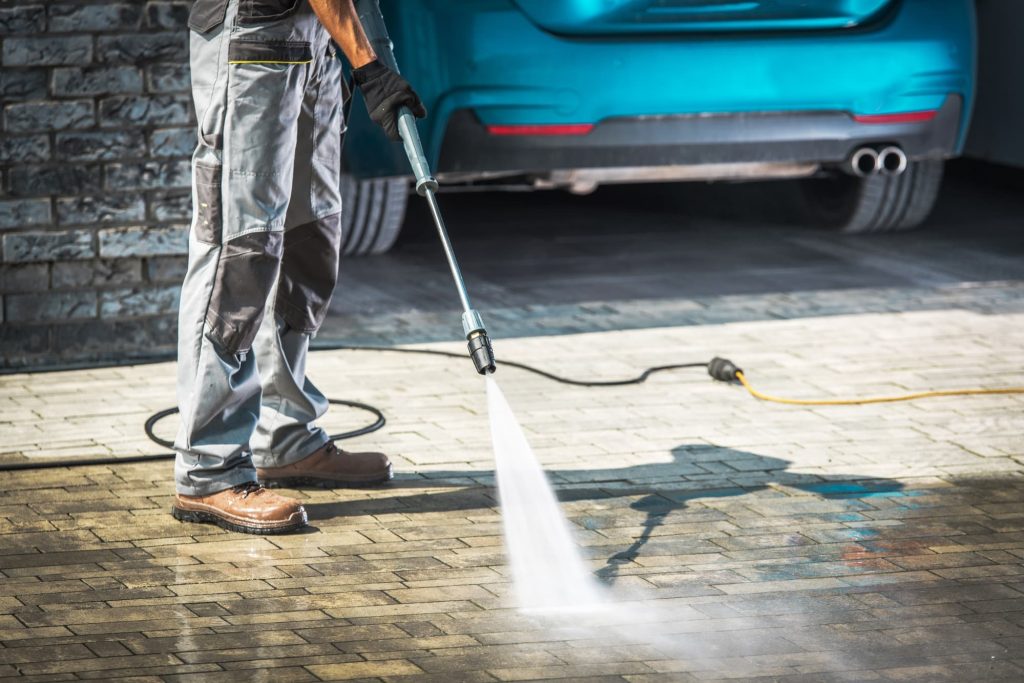
Concrete tolerates high pressure, so a bare wand will clean it. The problem is that a wand cleans in a narrow arc, and the overlap between passes is never perfectly even. What you get is a drive covered in faint wand marks that are invisible while wet and obvious once dry, in direct sun, for years. Concrete does not recover from this on its own.
The fix is a surface cleaner: a hood with spinning jets that spreads the force across a fixed width and moves at a consistent height. It cleans evenly, it works considerably faster, and it does not leave arcs.
A driveway usually carries several different problems at once, and one product will not handle them all. Green and black film is organic growth and needs a cleaning solution. Oil and transmission fluid need an alkaline degreaser and ideally hot water. Rust needs an acid, usually oxalic. Tyre marks are rubber transfer and need a degreaser plus agitation. Treating each separately before the general wash is what separates a clean drive from a slightly less dirty one.
Sweep first so you are not driving loose grit around under pressure. Pre-treat the specific stains and give each product its dwell time. Then run the surface cleaner in overlapping passes in one consistent direction, keeping the whole slab wet as you go so it does not dry unevenly behind you. Finish by rinsing the edges and any wand work with a wide fan so nothing dries at a different rate.
Driveway runoff carries whatever came off the slab. Keep degreaser and acid rinse away from planting beds and be conscious of where the drive drains. The grass strip along the edge is the usual casualty.
Not all concrete is the same. Stamped and coloured concrete has its colour in a thin surface layer and a sealer over it, and aggressive pressure removes both. Exposed aggregate loses stones. Older concrete that is already spalling or crazed will lose more surface if you hit it hard, because the damage is structural and pressure accelerates it. Any of those need lower pressure and more chemistry.
A penetrating sealer on a clean, fully dry slab fills the pores so future spills sit on top. Sealing over a slab that still holds oil or moisture traps the problem, so the order is clean, dry completely, then seal.
We run surface cleaners on flatwork and pre-treat stains separately, so the slab dries evenly rather than in arcs. Call (504) 688-3995 for a free written estimate.
In a humid climate the answer is driven by shade and tree cover far more than…
Read the guideStucco is porous, brittle at the surface, and sits over a moisture barrier, which makes it…
Read the guideComposite does not rot, but it does grow mould in its surface texture, and it is…
Read the guideFree written estimate before any work starts.