Professional Driveway Cleaning Before and After: Curb Appeal Results
Quick Answer: On a New Orleans driveway, a realistic result is concrete that comes back several shades lighter and evenly colored, with the mildew, algae, and tire tracks gone. What often stays is a faint shadow where oil soaked in for years, rust from rebar or fertilizer, and grooves from an old pressure-washing job. Knowing which of those you have before our driveway cleaning crew arrives keeps expectations honest.
The first time most homeowners see their driveway after a professional cleaning, the reaction is the same: “I didn’t know it was supposed to look like that.” The “before” they had been living with had crept in so gradually, a shade darker every season, that they’d lost the reference point for what clean concrete actually looks like. Below are four real-world transformation stories from NOLA driveways we’ve cleaned, organized by the kind of property you might own. Each one shows what changed, what made the difference, and what the homeowner noticed afterward.
Case 1: The Uptown Shotgun with the Forgotten Driveway
Before: A 1920s shotgun with a narrow 250 sq ft single-car driveway running along the side of the house. Surface had gone uniformly dark gray, with green-black streaking from a live oak overhead and a circular oil stain near the rear where the homeowner’s old truck had sat for years. The owners genuinely thought the concrete was “just that color” because they’d lived there 14 years and never seen it lighter.
The work: Soft-wash pre-treatment with a sodium hypochlorite mix to neutralize the organic staining, hot-water surface cleaner pass at 3,500 PSI, oil stain treated separately with a poultice over two days, full rinse and final detail.
After: The concrete came back nearly white in the cleaner sections, light gray in the older portions. The homeowner texted us a photo three days later, a real estate friend had walked by and assumed they’d just had the driveway poured new. They hadn’t planned to sell, but the comment changed how they thought about the rest of the property.
Case 2: The Metairie Paver Driveway That Was Hiding
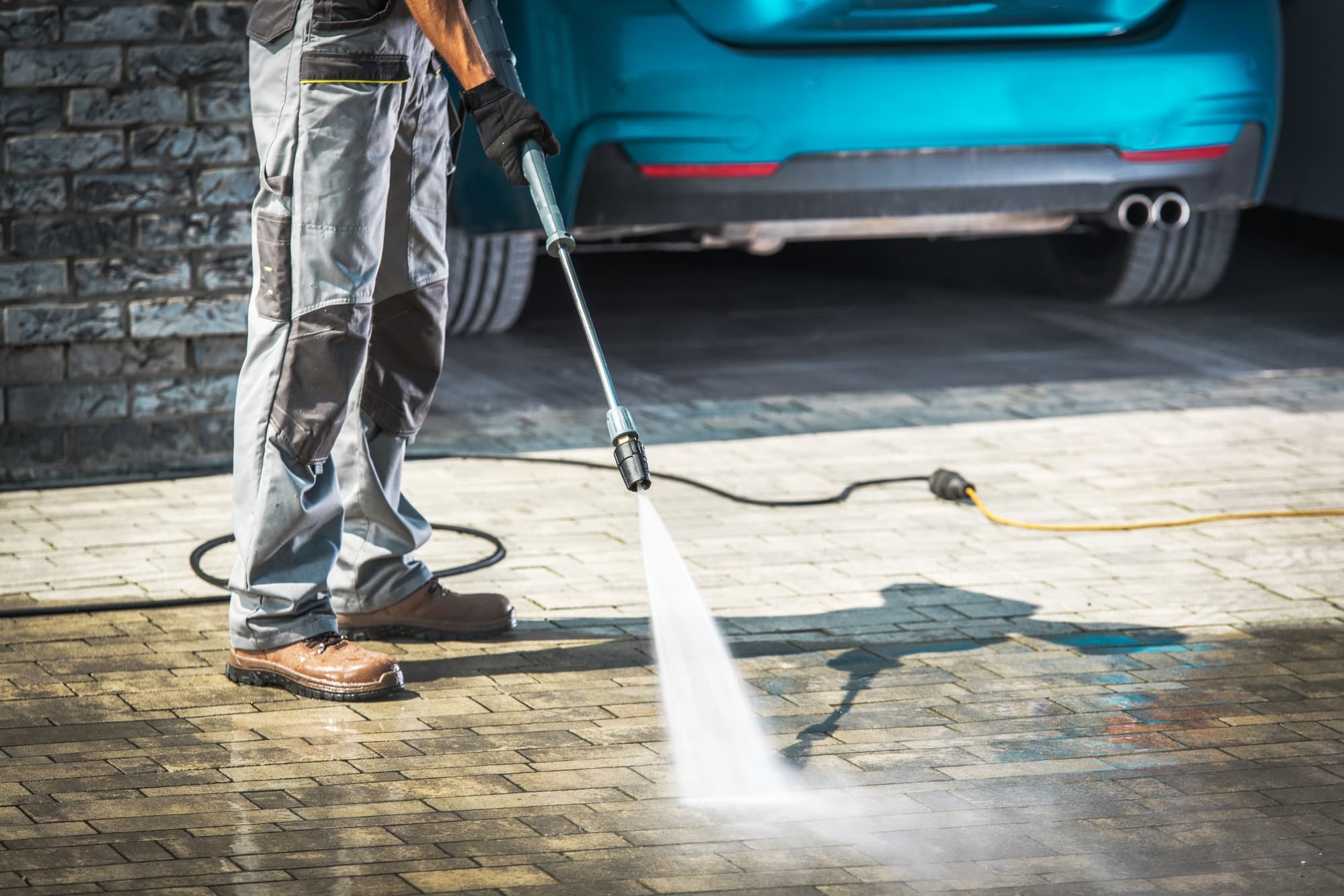
Before: A 900 sq ft paver driveway in front of a 2008-build home. The pavers had originally been a warm tan with darker accent borders. By the time we arrived, the entire driveway had gone uniform dark gray-brown, with weeds aggressively pushing through the joints and a moss colony in the shaded section near the garage. Homeowner thought the pavers needed to be replaced.
The work: Low-pressure soft wash across the entire surface, joint cleaning with a focused 250 PSI nozzle, weed extraction by hand, polymeric sand replacement in the joints, and a stabilizing rinse. No high pressure ever touched the pavers.
After: The original tan and accent-border pattern was visible for the first time in nearly a decade. The homeowner had budgeted $8,000 for paver replacement; the cleaning was $480. They added paver sealing as a follow-up project six weeks later to lock in the result.
Case 3: The North Shore Long Drive with the Stained Apron
Before: A 1,400 sq ft poured concrete drive on a Mandeville property, with a stained apron at the road that caught every drop of motor oil from the family’s two SUVs over six years. The drive itself had moderate organic staining; the apron looked permanently black for a 4-by-8 foot section. Homeowner had tried two DIY weekends with degreaser and a rented pressure washer with no visible improvement.
The work: Hot-water high-pressure cleaning across the main drive (35 minutes), then a focused two-pass treatment on the apron, alkaline degreaser dwell, agitation with a soft-bristle deck brush, second degreaser pass, hot-water rinse at close range with a 25-degree tip.
After: The main drive came back to near-original lightness. The apron lifted approximately 85%, a faint shadow remained where the oldest oil had penetrated deepest, but it was visually unrecognizable from the homeowner’s “before” photo. They’ve since put us on a quarterly schedule because the same vehicles still drip in the same spot.
Case 4: The Kenner Commercial-Style Residential Drive
Before: A wide 2,100 sq ft driveway servicing a home on a corner lot, with tire tracks visible from the homeowner’s daily out-and-back, mildew along the perimeter where the lawn meets the slab, and a generally tired appearance that the family said made the whole front of the house look older than it was.
The work: Full surface cleaner pass with hot water, perimeter soft-wash treatment for the mildew edges, and a finishing rinse to prevent runoff streaking onto the curb and the public sidewalk.
After: The drive looked “ten years younger” in the homeowner’s words, with the perimeter mildew gone and the tire tracks no longer visible. Three neighbors asked who had done the work in the first week. Two of them booked their own driveway cleanings within the month, exactly the kind of word-of-mouth pattern we see often, where one transformed driveway becomes a block-wide trend. It’s the same neighborhood logic behind commercial property exterior cleaning, visible cleanliness signals professionalism, whether the property is residential or commercial.
What Lifts and What Only Fades on a New Orleans Driveway
Most of what darkens a driveway here is organic: mildew, algae, and the black film that grows in shade and humidity. That comes out almost completely with the right pre-treatment, which is why so many metro driveways look dramatically lighter afterward. The stains that don’t fully lift are the ones that went into the concrete instead of growing on top of it.
- Old oil: a drip spot that has soaked for years usually lightens a lot and leaves a faint shadow. Our guide to removing oil stains from a driveway explains why repeat treatments beat one hard blast.
- Rust: orange marks from fertilizer granules, sprinkler water, or rebar near the surface need an acid-based rust remover, and a plain wash won’t touch them. See how to remove rust stains from concrete.
- Leaf tannins: brown outlines left by wet oak leaves and acorns often fade over a few weeks of sun after cleaning instead of vanishing on the day.
- Etching and wand marks: grooves cut by a narrow tip on an earlier job are damage to the surface, and cleaning makes them easier to see.
Timing matters too. A driveway washed after the spring pollen and leaf drop has passed holds its clean look longer than one washed just before it. Shaded sections under a canopy will always turn green first, so a realistic plan here includes a quick touch-up on those strips between full cleanings.
What These Four Cases Have in Common
Three things, every time:
- The “before” was invisible to the homeowner. Every one of these owners had stopped seeing their driveway as dirty. The stains had crept in slowly enough that the dirty version had become the new normal.
- The transformation was disproportionate to the cost. All four jobs landed between $180 and $480. None of them required new concrete, new pavers, new sealing, or new construction.
- The result changed how owners felt about the rest of the property. A clean driveway makes the rest of the front of the house look intentional. A dirty one makes everything else feel neglected.
That ripple effect is why we recommend pairing driveway cleaning with at least the adjacent walkways, see our breakdown of the benefits of regular sidewalk pressure washing. Hospitals, gyms, and offices apply the same logic, which is part of why workplace exterior cleaning has become standard maintenance for any property where appearance signals trust.
The Curb Appeal ROI Conversation
Real estate appraisers and listing agents have an internal shorthand: “the buyer decides in the first 30 seconds.” Most of those 30 seconds happen before anyone steps inside. The driveway is one of the three things visible from the curb (the other two being the front facade and the lawn), and it’s the single one most likely to be neglected because owners look right past it. Even if you’re not selling, the same psychology applies to how you experience your own home, pulling into a clean driveway every day is a quiet upgrade to ordinary life.
Frequently Asked Questions
How long does the “after” last?
For a NOLA driveway, the visible “fresh” look holds 4 to 6 months under typical conditions. Sealing extends that significantly. Recurring maintenance keeps the property in the “after” state continuously instead of cycling through dirty-and-clean.
Can I see before-and-after photos before I book?
Yes. Ask any company for at least three recent local examples on the surface type matching yours. Photos from a different climate or surface aren’t useful comparison data.
Is pressure washing safe for old concrete?
When the right method is matched to the surface, yes. Old, weather-aged concrete actually reveals the most dramatic before-and-after because decades of staining have built up.
Will my neighbors really notice?
In our experience, almost always, at least one neighbor comments within a week, often the same day. Driveways sit at eye level for everyone walking by, and a sudden shift from dark to clean is the kind of change people register without consciously realizing why.
Book the Transformation
If you’ve read this far, your driveway is probably already on your mind. The honest truth is that most homeowners delay this for years and then ask why they waited. There’s no advantage to the delay, the stains only get harder to remove, the curb appeal only gets quieter, and the cost only inches up with annual labor pricing. Pick a date, walk us through your driveway, and we’ll show you what’s underneath. Reserve a transformation slot and we’ll send you the before-and-after photo set the same day the crew finishes, yours to share, post, or just keep as proof of what was hiding the whole time.