Exterior Cleaning Guide
How to Clean Pavers
Pavers clean up well, but the joint sand between them is the part that decides whether the patio still looks right a month later.
Pavers clean up well, but the joint sand between them is the part that decides whether the patio still looks right a month later.
Cleaning the face of a paver is straightforward. The part that goes wrong is the sand in the joints. A narrow high-pressure jet strips joint sand out in seconds, and once it is gone the pavers lose their interlock, start to rock underfoot, shift out of line, and let weeds through from below. A patio can look excellent the day it is washed and noticeably worse a month later for exactly this reason.
So the job is really two jobs: clean the surface without excavating the joints, then replace the sand that inevitably comes out.
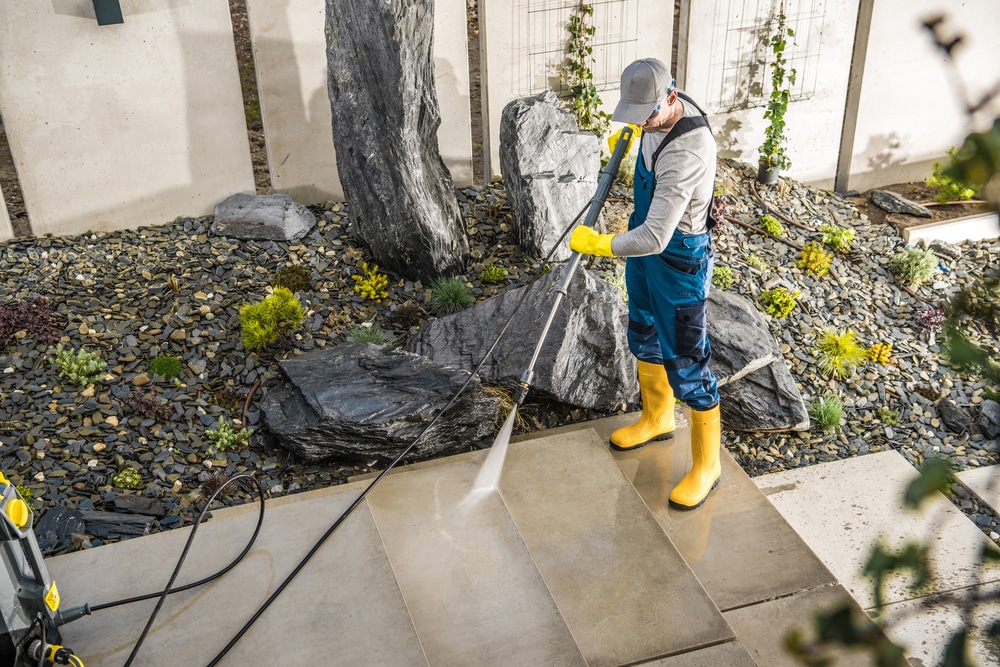
Use a surface cleaner rather than a wand where you can. It spreads the force across a spinning bar, cleans evenly, and does far less damage to joints than a concentrated jet. If you are using a wand, keep a wide tip, hold it back from the surface, and angle it along the joint lines rather than straight down into them.
Work in sections and keep the whole area consistently wet. Letting one part dry while you work the next is what causes the striping and tide lines that show up when the patio dries out.
Weeds growing between pavers are rooted in the joint sand, not in the ground beneath, so pulling the tops off achieves very little. Clearing the joint and re-sanding removes the growing medium, which is the actual fix. Moss and algae need a cleaning solution rather than force, and killing the growth means it stays gone longer than scraping it off.
The white haze that appears on new pavers is efflorescence, mineral salt drawn to the surface as the concrete cures. It is not a stain, it is not mould, and washing it usually does not remove it, because more moisture brings more salt up. It commonly clears on its own over the first year, and if it does not, it needs a dedicated efflorescence remover rather than a general wash.
Once the pavers are clean and completely dry, joint sand goes back in and gets swept and vibrated down until the joints are full. Polymeric sand sets firm once wetted and resists washout better than plain sand, though it has to go into a genuinely dry joint or it will haze the surface. Sealing afterwards is optional. It deepens the colour and makes spills easier to handle, but it needs the patio fully dry first or moisture gets trapped underneath and clouds.
We use surface cleaners on paver work and re-sand the joints as part of the job rather than leaving that to you. Call (504) 688-3995 for a free written estimate.
Those dark streaks are a living algae feeding on the limestone filler in your shingles, which…
Read the guideGreen film and black spotting on siding are two different organisms, and the black one does…
Read the guideThe choice is not about how dirty something is. It is about whether the surface can…
Read the guideFree written estimate before any work starts.